I periodically test the state of the current in coding agents by throwing them a fun project ... and last night I left that exercise quite impressed.
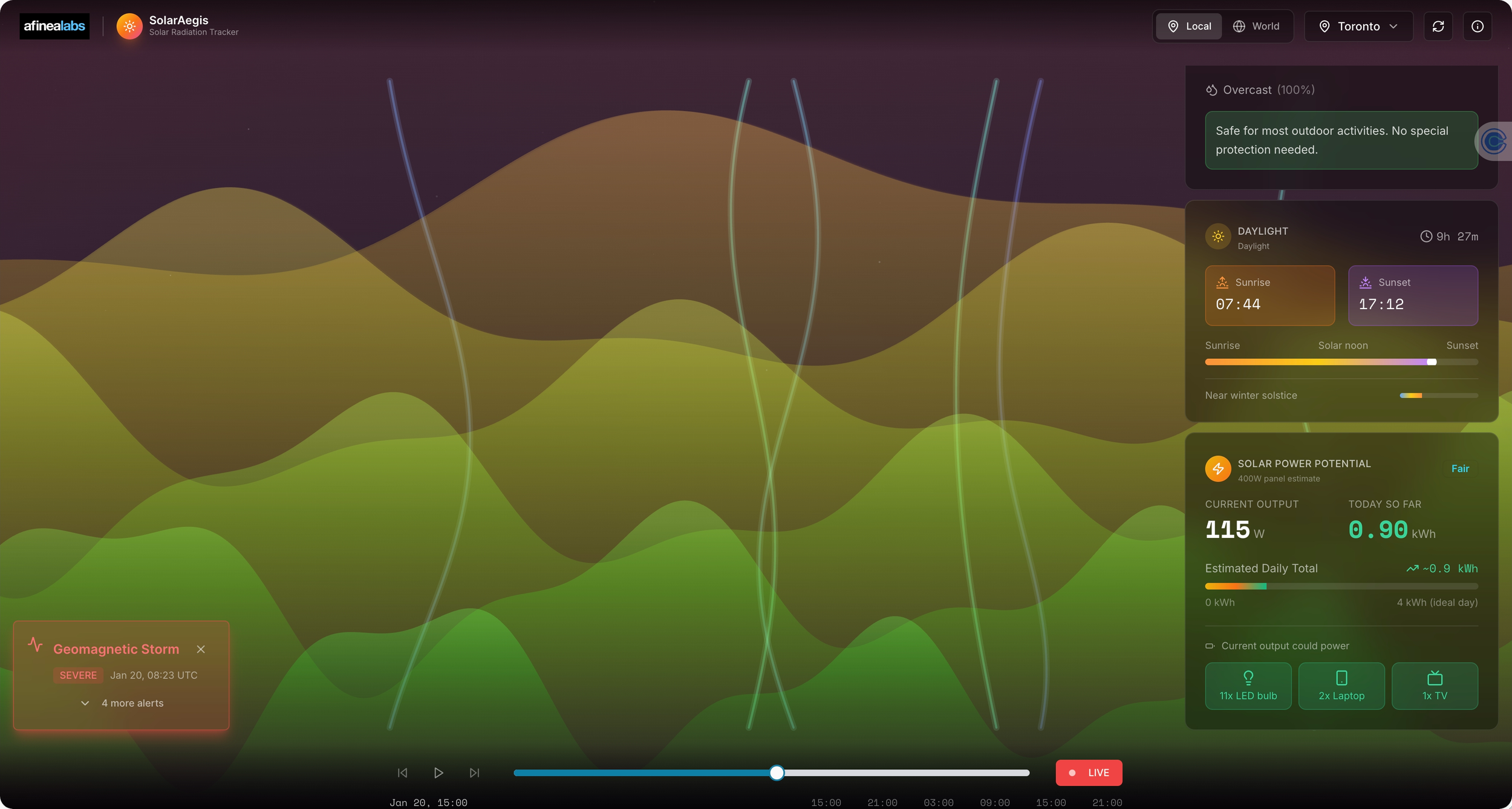
15 minutes. That's how long it took Replit to build a solar storm tracker for me.
Not a prototype. Not a wireframe. A fully functional app with aurora visualizations that shift from deep blues during low radiation to fiery oranges and reds during solar flares. Location search for anywhere in the world. NASA Alerts API integration. 24-hour historical data. A five-day forecast. Even a world map showing current solar activity.
A year ago, this same experiment would have hit what I call the "asymptotic problem"—you get something working quickly, then it just... stops getting better. Without significant handholding, you'd plateau at mediocre.
Not anymore.
What's changed isn't just speed. It's autonomy. The agent found its own bugs. Fixed them. Iterated through solutions. Made aesthetic choices I would have made myself. All while I watched and occasionally nudged.
I've been tracking this shift all year through my work with Claude Code. But seeing how accessible Replit's evolution has made coding crystallized something:
We are no longer technically limited.
For those of us in product, in startups, in building things, the constraint has fundamentally shifted. It's no longer "can we build this?" It's "can we imagine it?"
Think about where the puck was six months ago. Now think about where it'll be in six months.
For the ambitious and the imaginative, there's really no ceiling anymore.
Kudos to Replit for how far they've pushed this. The platform has matured remarkably.
Carpe Agentem.
#AgenticDevelopment #AI #Replit #SyntheticLeverage
Mark Ruddock
Thoughts of an internationally experienced growth stage CEO and Board Member.

Thoughts of an internationally experienced growth stage CEO and Board Member
Mark Ruddock
Thoughts of an internationally experienced growth stage CEO and Board Member.
Experienced international CEO with three exits and over 20 years of experience at the helm of VC-backed technology and fintech startups. I've founded companies and come in as a later-stage CEO to help existing companies scale. My experience spans multi-country online financial services, mission-critical enterprise software and consumer-focused mobile applications.
Currently CEO of Kontent.ai, the industry's first CMS with native AI capabilities, kontent.ai helps the world's leading organizations generate an unparalleled return on their content by enabling them to create, manage, distribute, and optimize their content at scale with unprecedented speed oversight, and security.
Before that, I was CEO of Nuula (formerly known as BFS Capital), which Nav acquired. At Nuula, we believed there was a better way to help run your small business — so we built it. Nuula is a mobile application that gives small business owners instant access to critical business metrics and innovative financial products anytime, anywhere. It provides small business owners with the tools, content, and capital they need to be successful in a modern, competitive market.
Prior to that interim CEO of 4finance. Agreed to take on an interim role to help clarify strategy, accelerate the critical transformation of the business and set the company on a course for the next growth phase.
Before that, I was Managing Director, International at Wonga, responsible for overseeing all businesses outside of the UK, including consumer lending businesses in Canada, Spain, Poland and South Africa and our eCommerce and product financing business BillPay in Germany. Prior to that was CEO of Wonga Canada.
Prior to that, I was EO Viigo. When Viigo was acquired by Blackberry in 2010, the company had hundreds of partners, won numerous awards, including “PC Magazine’s Editors Choice“, the “Most Promising New Company of the Year” from the CNMA, and the “Wireless Leadership Award” from RIM, signed marquee enterprise customers such as Oppenheimer, UBS, BAT and Scotts and been downloaded over 3MM times, becoming one of the most popular BlackBerry apps of all time.
I started my career as the Founder and CEO of INEA. A software company that was a strategic partner to many of the world's leading financial institutions, INEA had deployments in over 44 countries. Backed by RBC, Ventures West, APAX and Edgestone, the company was acquired in June 2005 by Cartesis. Cartesis was subsequently acquired by Business Objects in 2007, which was later acquired by SAP.
AFINEA | 136 Arundel Ave, Toronto